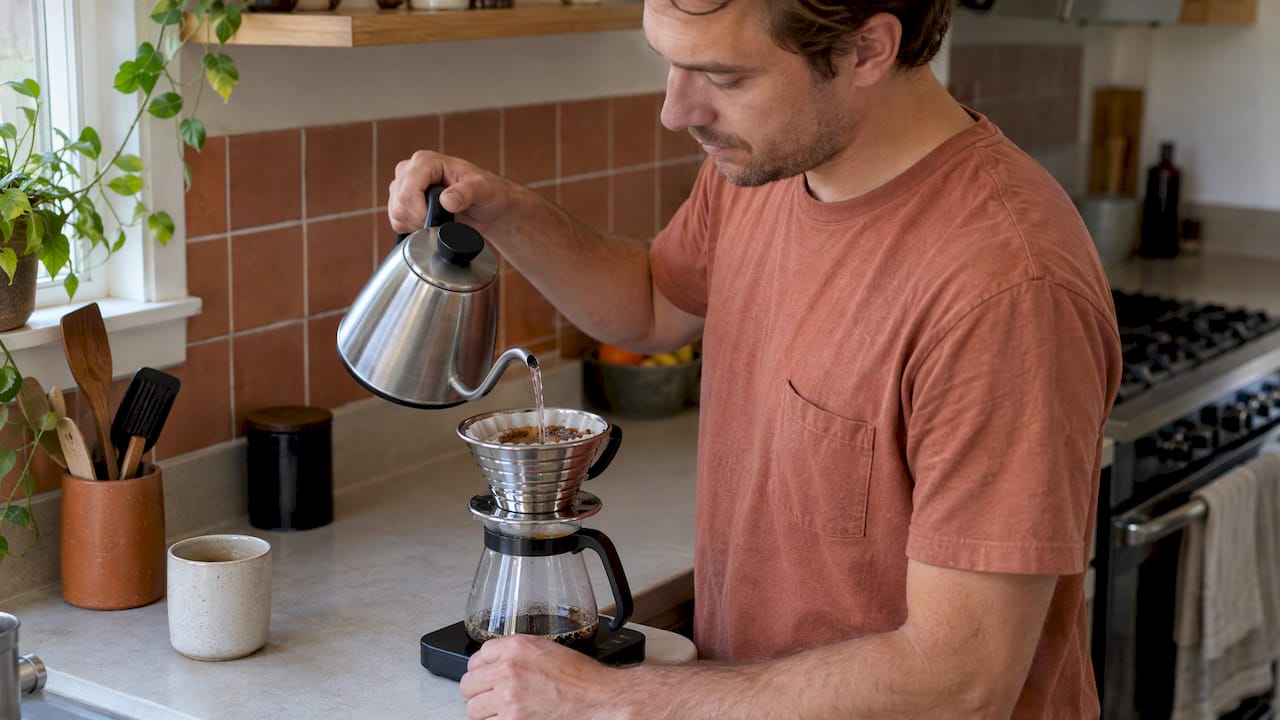
Hario Switch Recipe: Two Brews for Light Roasts

The best Hario Switch recipe for everyday light-roast coffee is simple: 15 g of medium-fine coffee, 240 g of hot water (a 1:16 ratio), the valve closed for the first 2:30, then open to drain, finishing around 3:30. Below you get that recipe step by step, a hybrid version for more clarity, the one-variable method for fixing a cup that tastes off, and a straight answer on the Switch versus a V60.
TL;DR
- Start with 15 g coffee, 240 g water at 205°F (96°C), medium-fine grind, valve closed for the first 2:30, total time near 3:30.
- The Switch is a V60-style dripper with a valve. Closed, it steeps like an immersion brewer. Open, it drains like a pour-over.
- Want more clarity? Use the hybrid recipe: open for the bloom and first pour, close to steep, then open to finish.
- Change one thing per brew: grind first, then temperature, then ratio, then valve timing.
- Fresh, ultra-light single origins show the difference between immersion and percolation most clearly.
Table of Contents
- What the Hario Switch actually does
- What you need
- Recipe 1: Immersion Switch brew (15 g to 240 g)
- Recipe 2: Hybrid Switch brew for more clarity
- Fixing the cup: one variable at a time
- Brewing ultra-light roasts in the Switch
- Hario Switch versus V60: which should you brew with?
- Common mistakes
- Fresh beans for your Switch
- FAQ
- Sources
What the Hario Switch actually does
The Switch is a cone dripper with a small valve at the base. Hario USA describes it as a modified V60 hybrid that can brew as a standard V60 pour-over or as an immersion brewer. You add coffee, a standard 02 or 03 V60 filter and hot water, let the coffee steep with the switch closed, then flip the switch to start the drawdown. The same page lists a borosilicate glass bowl, a resin switch and a stainless-steel ball inside the valve, in a 200 ml size and a 360 ml size.
That valve changes what you can control. In a regular pour-over, water leaves the coffee bed as soon as you pour it, so your only levers are grind, pour pattern and flow. With the Switch you also choose how long the water and coffee sit together before any water leaves. Longer contact tends to build sweetness and body. Percolation, the water flowing through the bed, tends to lift clarity and aroma. The Switch lets you pick the balance of the two in one brewer.

That is also why it suits light roasts. Light-roasted coffee is dense and soluble only with enough heat and time, and a closed valve gives you both without relying on a perfect pour.
What you need
- A Hario Switch (02 size works for one or two cups) and 02 paper filters
- A scale that reads to 0.1 g and a timer
- A gooseneck kettle, or any kettle you can pour from steadily
- A burr grinder
- 15 g of freshly roasted whole beans, ideally roasted within the last few weeks
- Water at 205°F (96°C), which is about 30 to 45 seconds off the boil in a typical kettle
Use filtered water if your tap water is hard or heavily chlorinated. Water chemistry changes extraction more than most home brewers expect, and it is the cheapest upgrade you can make.
Recipe 1: Immersion Switch brew (15 g to 240 g)
This is the forgiving recipe. Because most of the brew happens with the valve closed, a slightly uneven pour does not matter. It is the one we suggest when you are learning a new bag.
Recipe card
| Item | Amount |
|---|---|
| Coffee | 15 g, medium-fine (a little finer than table salt) |
| Water | 240 g at 205°F (96°C) |
| Ratio | 1:16 |
| Valve | Closed to start |
| Total time | About 3:30 |
Steps
- Close the valve and rinse the filter. Fold a 02 filter into the dripper, close the switch, and pour in a little hot water to rinse out the paper taste and heat the glass. Open the switch to drain the rinse water into your server or sink, then close it again. Where it goes wrong: skipping the rinse leaves a papery edge, and forgetting to close the valve before the coffee goes in sends the bloom straight into the cup.
- Add the coffee and tare. Pour 15 g of ground coffee into the dripper, level the bed with a gentle shake, and zero the scale.
- Bloom (0:00 to 0:45). Start the timer and pour 45 g of water, about three times the weight of the coffee, wetting all the grounds. Give the slurry a quick swirl. Fresh coffee releases gas here, so you will see it puff. That gas is a good sign the beans are fresh.
- Fill (0:45). Pour up to 240 g total, steadily, over about 15 seconds. Stir once, gently, back and forth, to break up any dry clumps.
- Steep (to 2:30). Leave the valve closed. Resist the urge to stir again.
- Open and drain (2:30). Place the Switch on your server or mug and flip it open. The bed should drain in about a minute, finishing near 3:30.
- Swirl and taste. Give the finished coffee a swirl. Light roasts open up as they cool a few degrees, so taste at two points.
If you want a point of reference, Hario’s own recipe sheet lists a simple version using 14 g of coffee and 190 g of water at 93°C: pour 70 g with the valve closed, pour up to 190 g at 0:45, open the valve at 2:30 and remove the dripper at 3:00. It follows the same shape as the recipe above, closed first and open late, and the sheet notes that grind size is the main variable to play with.
Recipe 2: Hybrid Switch brew for more clarity
Immersion is generous and sweet. If you find a cup a little heavy, or you want the floral and tea-like side of a washed Ethiopian to speak louder, put some percolation back in.
| Item | Amount |
|---|---|
| Coffee | 15 g, medium-fine |
| Water | 240 g at 205°F (96°C) |
| Ratio | 1:16 |
| Valve | Open, then closed, then open |
| Total time | About 3:15 |
- Valve open, rinse and add coffee. Rinse the filter with the valve open, discard the water, and add 15 g of coffee.
- Bloom (0:00). Pour 45 g and let it drip for about 40 seconds. With the valve open, the bloom drains and the bed forms a flat, even layer. An even bed is what you want before you close the valve.
- First pour (0:40). Pour to 140 g over 15 seconds in slow circles, keeping the valve open.
- Close the valve (1:10). Flip it closed and pour up to 240 g. The coffee now steeps in the full volume of water.
- Open (2:10). Flip the valve open and let it drain, ending around 3:15.
What you are doing is borrowing from both methods. The open phase builds an even bed and brings out aromatics, and the closed phase adds sweetness and body. At the 2024 US Brewers Cup, champion Weihong Zhang told Hario he chose a Switch-style brewer because immersion increased contact time to capture sweetness while switching to percolation mid-brew preserved acidity, and that it gave him high repeatability across three cups. The hybrid recipe applies the same idea at home, with a calmer pace.
Fixing the cup: one variable at a time
A recipe is a starting point. Every coffee is a little different, and your grinder and water will move the result. The rule that holds up best at home is to change one thing per brew and write it down. We cover the logic in more depth in our one-variable rule for bitter coffee, and it applies directly to the Switch.
If the cup tastes sour, thin or sharp (under-extracted)
- Grind a notch finer first. This is the biggest lever.
- If it is still thin, lengthen the closed-valve steep by 20 to 30 seconds.
- After that, try water a few degrees hotter, up to the point just off boiling.
If the cup tastes bitter, dry or muddy (over-extracted)
- Grind a notch coarser.
- Shorten the steep, or open the valve earlier.
- Then try water a few degrees cooler.
If the bed drains very slowly after you open the valve
You are probably too fine, or the fines have clogged the paper. Coarsen a step and stir less. Fast-draining or very coarse grinds do the opposite: the Switch keeps them in contact with water for the full steep, which makes them easier to extract than in an open pour-over.
If you want a stronger cup
Change the ratio rather than the grind. Move from 1:16 toward 1:15 (15 g with 225 g of water). A stronger cup comes from more coffee per water, not from over-extracting.
Our V60 grind size guide shows what each step looks like in the cup, and the same adjustments carry over to the Switch.
Brewing ultra-light roasts in the Switch
Ultra-light, Nordic-style roasts are roasted gently to keep the fruit, florals and acidity of the origin intact. They also resist extraction. A cooler, shorter brew can leave them grassy or sour.
The Switch helps because it removes two of the things that make light roasts hard in a pour-over: temperature loss during a long pour, and dependence on a precise pour pattern. A few habits make a bigger difference:
- Use hot water. Start at 205°F (96°C). If the coffee is very dense, go a little hotter.
- Grind medium-fine, not coarse. Light roasts are dense and need the surface area.
- Let the coffee rest. Beans a week or two off roast give a calmer bloom and a cleaner cup than beans a day or two off roast. A very fresh bag may need a longer bloom to degas.
- Use a longer steep for dense, washed coffees and a shorter one for delicate, floral ones.
- Keep a hybrid recipe ready. Washed Ethiopians and Kenyans often do well in the hybrid. Naturals and sweeter Colombians often do well in full immersion.
We lay out the wider options in our light roast brewing methods list, and our filter versus immersion comparison goes deeper on how a 1:16 ratio behaves in each style.
Hario Switch versus V60: which should you brew with?
The two share a shape and a filter, so the question is really about control. The Switch is a V60-style dripper with a valve, so it can do everything a V60 does, and it can also steep.
| V60 | Hario Switch | |
|---|---|---|
| Brewing style | Pour-over (percolation) | Pour-over, immersion or a mix |
| Filters | 02 or 03 V60 paper | 02 or 03 V60 paper |
| What you control | Grind, pour pattern, flow | Grind, pour, plus steep time and valve timing |
| Strong point | Clarity, bright acidity | Sweetness, body, repeatability |
| Technique demand | Pour skill matters | Pour skill matters less during the closed phase |
Both are excellent. A V60 shows you a coffee with a bright, transparent profile, and a washed light roast from Ethiopia is a classic match. The Switch is the better choice when you want consistency from day to day, when you are brewing for guests, or when you want to taste the same bean two ways. If you are building your skills on the V60, our 15 g to 240 g V60 light roast recipe and our pour over guide give you the baseline to compare against.
A useful experiment: brew the same bean three ways on the same morning. Do the V60-style open brew, the full immersion and the hybrid, using the same grind and 15 g to 240 g each time. Taste them side by side as they cool. Most people find a clear favorite for each bean within one session, and that is more informative than any rule.
Common mistakes
- Forgetting to close the valve before the pour. Everything drains into your cup. Close it before you add water, and check by looking at the base.
- Not rinsing the paper. The filter flavor can mask a delicate coffee.
- Changing three things at once. If you change grind, ratio and time together, you will not know which one fixed or broke the cup.
- Stirring aggressively during the steep. A single gentle stir is enough. Hard stirring pushes fines into the paper and slows the drawdown.
- Brewing stale beans. Immersion shows flaws as easily as virtues. Old coffee tastes flat in any brewer.
What we would tell you at the bar
We roast ultra-light, Nordic-style single origins, and we ship them on the day they are roasted. That is the context for everything we say about brewing the Switch. When a coffee is roasted this gently, the most useful thing a brewer can give you is time and heat without fuss. The Switch does that, and it lets you decide how much clarity you want in the cup.
Our advice is to start with the immersion recipe, learn what the coffee tastes like, then move to the hybrid when you want more lift. Keep notes on the grind setting. Tell us what you taste, because our subscription is built around your feedback: the more you say about how a coffee landed, the closer the next selection gets to your taste.
The Switch and the V60 are not rivals in our kitchen. They are two ways to listen to the same bean.
Sean
Fresh beans for your Switch
A good recipe only works as well as the coffee in the dripper. Our subscription ships freshly roasted single origins on the day they are roasted, in ultra-light, Nordic-style roasts, so the coffee arrives ready for the recipes above. Choose a plan, tell us how each coffee tasted, and we personalize your next selections around your feedback. You can browse everything on our plans page.

Buying for someone who already owns a Switch? Our gift subscriptions give them a rotation of fresh single origins to brew with it.
FAQ
What is the best Hario Switch recipe?
For most light roasts, 15 g of medium-fine coffee with 240 g of water at 205°F (96°C) is a strong starting point. Keep the valve closed for the first 2:30, then open it and let it drain, finishing around 3:30. From there, change only one variable at a time to suit the bean.
What does the Hario Switch do?
It is a V60-style dripper with a valve at the base. Hario describes it as a hybrid that brews either as a pour-over or as an immersion brewer. Closed, the water and coffee steep together. Open, the coffee drains through the paper filter.
What grind size should I use in a Hario Switch?
Medium-fine is the usual starting point, a little finer than you might use for a faster pour-over. Sour or thin coffee means go finer. Bitter or muddy coffee means go coarser. Hario’s recipe sheet also points to grind size as the main variable to adjust.
How much coffee should I use in a Hario Switch?
The 02 size handles 14 to 20 g comfortably for one or two cups. Our baseline is 15 g with 240 g of water, a 1:16 ratio. Go to 1:15 for a stronger cup or 1:17 for a lighter one.
Can I use the Switch like a normal V60?
Yes. Keep the valve open and pour as you would in a V60. The same 02 or 03 paper filters fit, according to Hario USA.